
Crossing the Atlantic by Sailboat: A Guide to Getting Started
Three weeks at sea, October to January, bound for the Caribbean. Finding a serious boat, avoiding bad skippers, life on board: my 2024 experience.
Loïc Dupont6 min read
Contents
In short Crossing the Atlantic by sailboat usually means three weeks at sea between the Canaries or Cape Verde and the Caribbean, setting off between October and January to make the most of the trade winds. Without a boat of your own, you sign on as crew: the hard part isn't knowing how to sail, it's finding a serious project and a skipper you can trust. The toughest thing on board isn't technical, it's human.
I made my first Atlantic crossing by sailboat in 2024. It took me two months and two attempts, for three weeks at sea between Cape Verde and Barbados. This guide covers what I learned, with figures from the listings gathered on EveryTransatlantic, and at each step points you to the article that goes into the topic in detail.
What does an Atlantic crossing by sailboat look like?
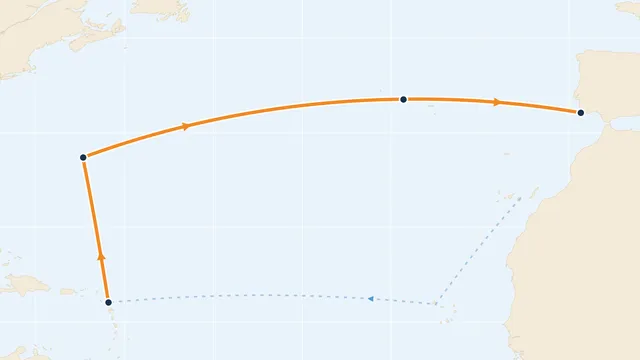
My second attempt set off from La Rochelle. We sailed down along northern Spain and Portugal, then on to the Canaries and Cape Verde. From there, three weeks at sea to Barbados. We then worked our way north via Martinique to Guadeloupe.
This is the classic outbound route, the trade wind route: you head south until you pick up those steady easterlies, then run west. Between Gran Canaria and Saint Lucia, the ARC rally covers 2,700 nautical miles (about 5,000 km), sailed in 18 to 21 days by an average yacht, according to its organiser. For a breakdown by type of boat, see how long the crossing takes.
Whether you leave from the Canaries or Cape Verde, the Canaries, Cape Verde, Caribbean page shows the current listings on this route. The other itineraries, including the return via the Azores, are described in the outbound and return transatlantic routes.
When to go?
The outbound crossing happens at the end of the year. The Atlantic hurricane season officially runs from 1 June to 30 November, according to the US weather agency NOAA: you wait for it to end before arriving in the Caribbean.
The listings bear this out. In the 2025-2026 season, 541 transatlantic listings were posted on the site. 59% planned a departure between October and January, with November in the lead at 102 departures. The return to Europe happens in spring. The months to favour and the ones to avoid are in the right month to set off.
Without a boat: finding a berth that will actually sail
I nearly gave up. There are a lot of disappointments: skippers who don't know where they're going or when they want to leave, who have no real intention of going. Boats that aren't technically ready. Last-minute cancellations because people get scared of crossing the Atlantic.
My first attempt ended right there. I was with a Belgian couple, setting out from southern Portugal, who pulled out before the crossing. I knew I was really going to cross when I found a serious project: a delivery. A Serbian captain had to take a new boat to the British Virgin Islands, where it would go into charter. A date, a destination, a reason to go: that's what makes a departure that actually happens.
Spotting a serious project
Before committing, ask the skipper three questions. What's the departure date, and what could push it back? Is the boat ready, and what's still left to do? Why is he crossing? A vague answer to any of them often signals a false start. For the rest of the conversation, read what skippers expect from crew.
Searching at the right time, and fast
You need to start looking from October-November, and keep going until the end of February. You have to be diligent and quick: reply to listings as soon as they go up.
The numbers explain why. On the outbound route in the 2025-2026 season, there were 327 crew listings for 57 skipper listings, close to six crew members per boat. Half of skipper listings come in less than 40 days before departure. Listings arrive mostly from September to January, peaking in October.
If I did it again, I wouldn't search by hand anymore. I'd get notified of every listing relevant to me, for the crossing as well as the passages leading up to it. On EveryTransatlantic, that's what happens when you post your crew listing: the site emails you as soon as a skipper listing matches your route and dates. You can also browse the current listings.
The return is less competitive: 86 crew for 71 skippers in the same season. If your dates are flexible, the return crossing is the easiest way in.
All the ways to find a berth, from listing sites to the docks, are gathered in our guide to finding a boat. Two of them have their own article: how a crew exchange works and boat-hitching on the docks.
The real risk isn't the storm
The real risk is ending up with an ill-intentioned captain, especially for women. At sea, you're stuck. In the end, the big risk is the crew: the other crew members, but also the captain.
I recommend sailing with a mixed crew, and steering clear of boats with only women aboard and a lone male captain. Make things as safe as you can before leaving: talk at length, meet the skipper, sail with him beforehand if you can.
The hardest part on board: living together in a few metres
What surprised me wasn't the technical challenge. It was that the human experience turned out to be the hardest: everyone's wishes, everyone's habits, living as a group in a tiny space, for three weeks.
On the sailing side, the rhythm is set by watches, the rotating shifts that keep lookout day and night: see how watches are organised and what's expected of a beginner on board.
Preparing your crossing as crew
Three questions come up before leaving. Do you need to know how to sail already? See the level of experience required. What should you pack? Follow the gear list. How much does it cost? Allow between €500 and €2,500 as crew, broken down in the budget for a transatlantic crossing.
Are you a skipper looking for crew?
On the outbound route, crew are plentiful: you have the pick. What to look for and what to ask is in finding crew for a transatlantic.