
What skippers really expect from crew (and how much they ask)
We read 1,312 skipper listings: a median contribution of €20 per day, almost as many accepting beginners as requiring experience, and the skills that make the difference.
L'équipe EveryTransatlantic3 min readUpdated on

Contents
Before writing to a skipper, two questions always come up: how much will it cost me, and do I have the right profile? Rather than generalities, we read what skippers actually write: 1,312 listings posted on EveryTransatlantic between June 2025 and May 2026.
In short
- When a skipper puts a figure on the cost-sharing contribution, it's €20 per day per person at the median (half of listings between €15 and €25).
- Above €40 per day, it's no longer cost-sharing: these are paid offers (sailing courses, cabin charters), around €100 per day.
- Experience is required in 17% of listings, but 14% explicitly say beginners are welcome.
- What makes the difference after that: team spirit, cooking, English, night watches.
How much do skippers ask?
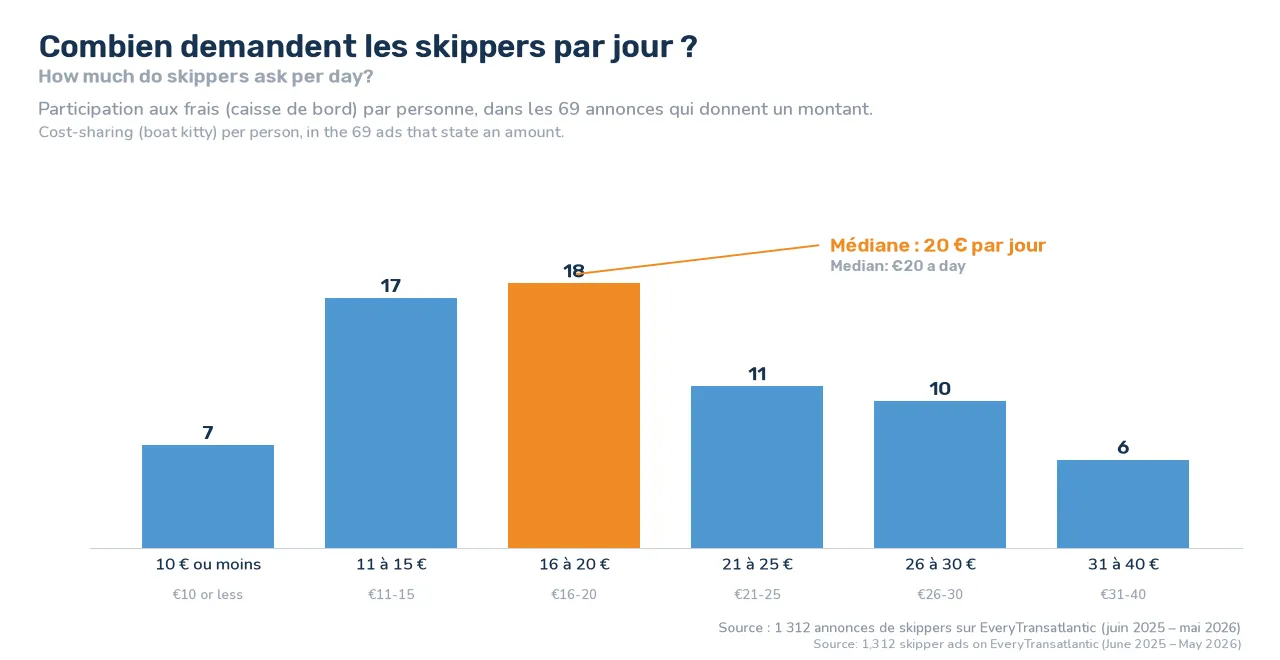
Among listings that give an amount, the vast majority fall between €15 and €25 per day. This "boat kitty" generally covers food, diesel and marina fees. It almost never includes your flight home or your personal gear.
Here's what that adds up to, depending on how long you're aboard:
| Time aboard | €15 / day | €20 / day | €25 / day |
|---|---|---|---|
| 1 week | €105 | €140 | €175 |
| 3 weeks (one crossing) | €315 | €420 | €525 |
| 5 weeks (the return via the Azores) | €525 | €700 | €875 |
Only 1% of listings mention sailing for free. So always budget for a contribution, and get it spelled out before you commit. For the full budget (flights, gear, contingencies), see the real cost of an Atlantic crossing.
Cost-sharing or paid offer: knowing the difference
18 listings ask for more than €40 per day, with a median of €100 per day, sometimes quoted by the week (€750 to €980). These aren't crew searches but paid services: sailing courses, cabin charters, places in a rally.
Nothing wrong with that, but it's not the same deal. Before replying, ask: is this sharing the boat's running costs, or is it a price? If it's the latter, ask what's included (insurance, food, instruction).
What skippers expect from crew
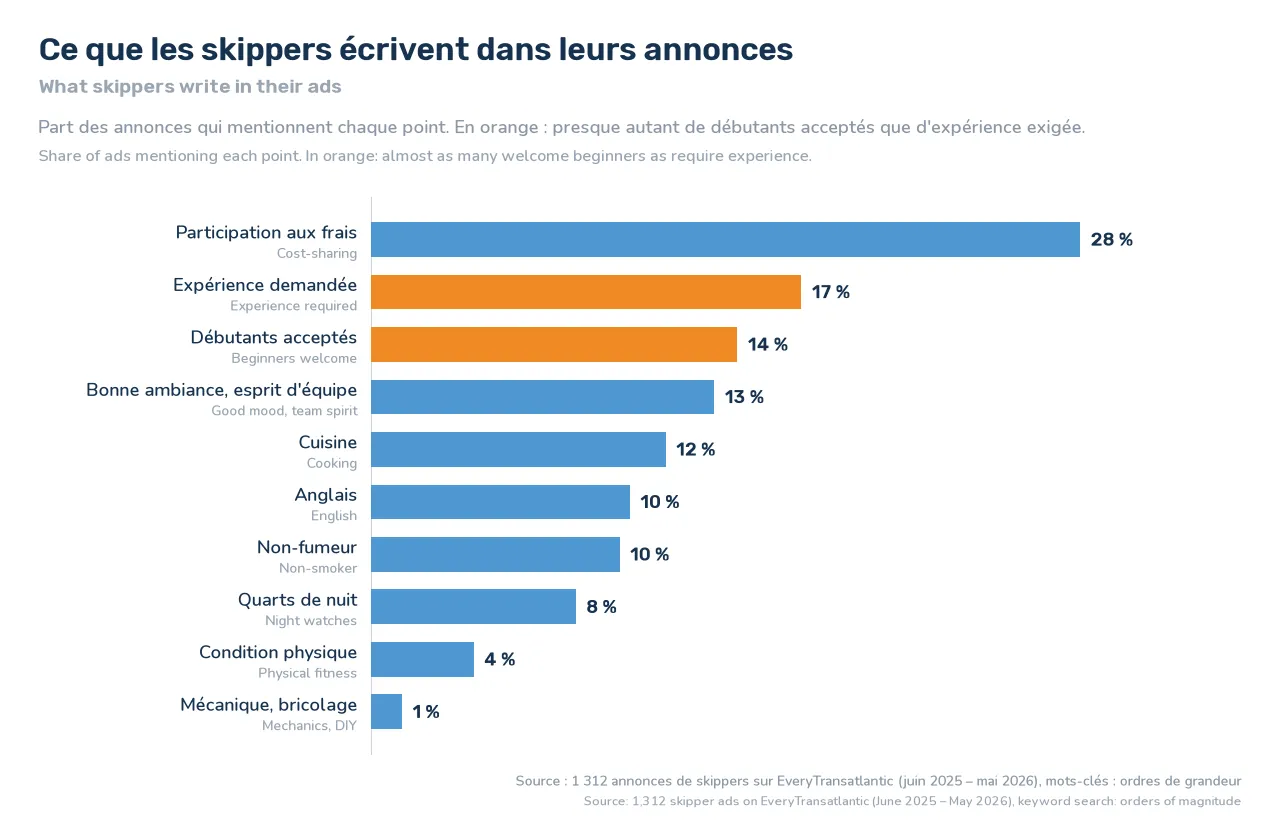
- Experience isn't a barrier. Barely more listings require it (17%) than explicitly welcome beginners (14%). If you're just starting out, read how much experience you need for an Atlantic crossing.
- Attitude counts as much as skills. Good humour and team spirit are mentioned in 13% of listings: you'll be living in a few square metres for weeks.
- The skills that make the difference are simple: cooking (12%), speaking English (10%), standing a night watch (8%), not smoking (10%).
- Rare skills are a real asset. Mechanics or DIY (1%) and first aid (under 1%) are rarely asked for, so candidates rarely highlight them. If you have them, say so.
Your first message to a skipper: the checklist
- Your dates and flexibility: it's the first thing the skipper checks.
- Your experience, honestly: miles logged, night sailing, or "motivated beginner", which is a real profile.
- What you bring aboard: cooking, English, DIY, first aid.
- Your agreement on the cost-sharing contribution, with a specific question: how much per day, and what does it cover?
- A link to your profile, with a photo and a bio: it's your sailing CV.
See skipper listings looking for crew
Frequently asked questions
Does the boat kitty include flights?
Almost never. It covers life aboard (food, diesel, marinas). Getting to the boat and getting home are at your own expense.
Can you negotiate the cost-sharing contribution?
It's often open to discussion, especially if you bring a useful skill or if the skipper is struggling to fill the crew. That's the case, for example, on the return crossing.
Method: 1,312 skipper listings posted on EveryTransatlantic (June 2025 to May 2026), including listings sourced from other sites. Amounts recorded when the listing gives a price per day, per week or per month (converted to a daily rate; for ranges, the midpoint). Criteria identified by keywords in French and English: these are orders of magnitude.