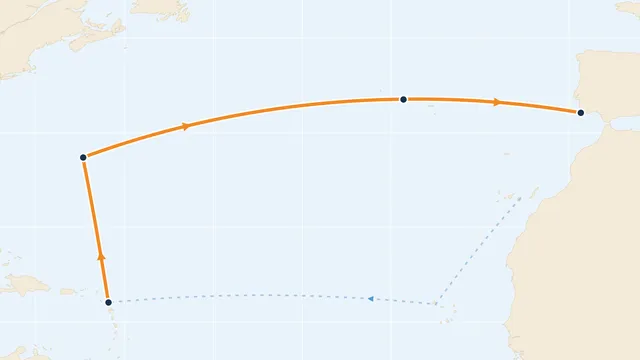

Skippers: finding crew for the return Atlantic crossing
On the Caribbean to Europe return, there are 2 skippers for every crew member. Timing, route, legs and a listing that convinces: how to complete your crew in time.
L'équipe EveryTransatlantic7 min read

Contents
Your boat has crossed to the Caribbean, and now it has to come back. On this leg the roles are reversed: on the way out, crew queue up for a berth; on the way back, it is the skipper who has to make the case. We looked at 3,144 listings posted on EveryTransatlantic to understand why, and how to complete your crew in time.
In short
- On the outbound crossing there are 3.9 crew per skipper. On the return, 0.5: two skippers for every crew member.
- 72% of skippers leave in April or May. Crew, on the other hand, are mostly available from March.
- With stopovers, the return takes 5 to 7 weeks, almost twice as long as the outbound trip. That is the main thing holding crew back.
- What works: post from January, offer legs (Caribbean to Azores, Azores to Europe) and write a complete listing.
On the return, crew get to choose
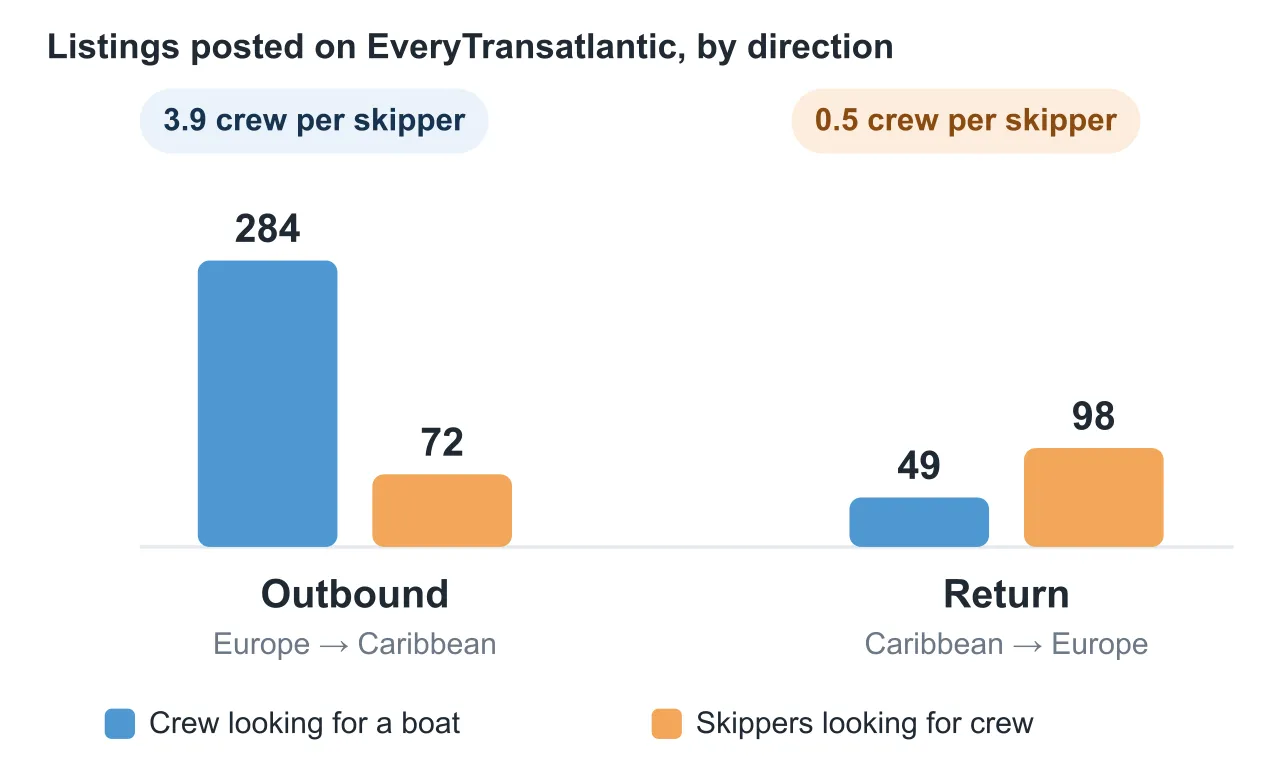
The contrast is stark. The outbound crossing is the dream: sunshine, trade winds, landfall in the Caribbean. The return attracts far fewer people, for three reasons:
- It is long. 5 to 7 weeks with stopovers, versus about 3 weeks for the outbound crossing. Few people can take that much time off.
- It is more demanding. Bigger seas, more sail handling, cold nights after the Azores.
- Many outbound crew already have a plane ticket home.
The result: a skipper who posts a listing three weeks before departure and waits for applications may end up leaving two-handed, or not at all.
The right timing: post early, leave before June
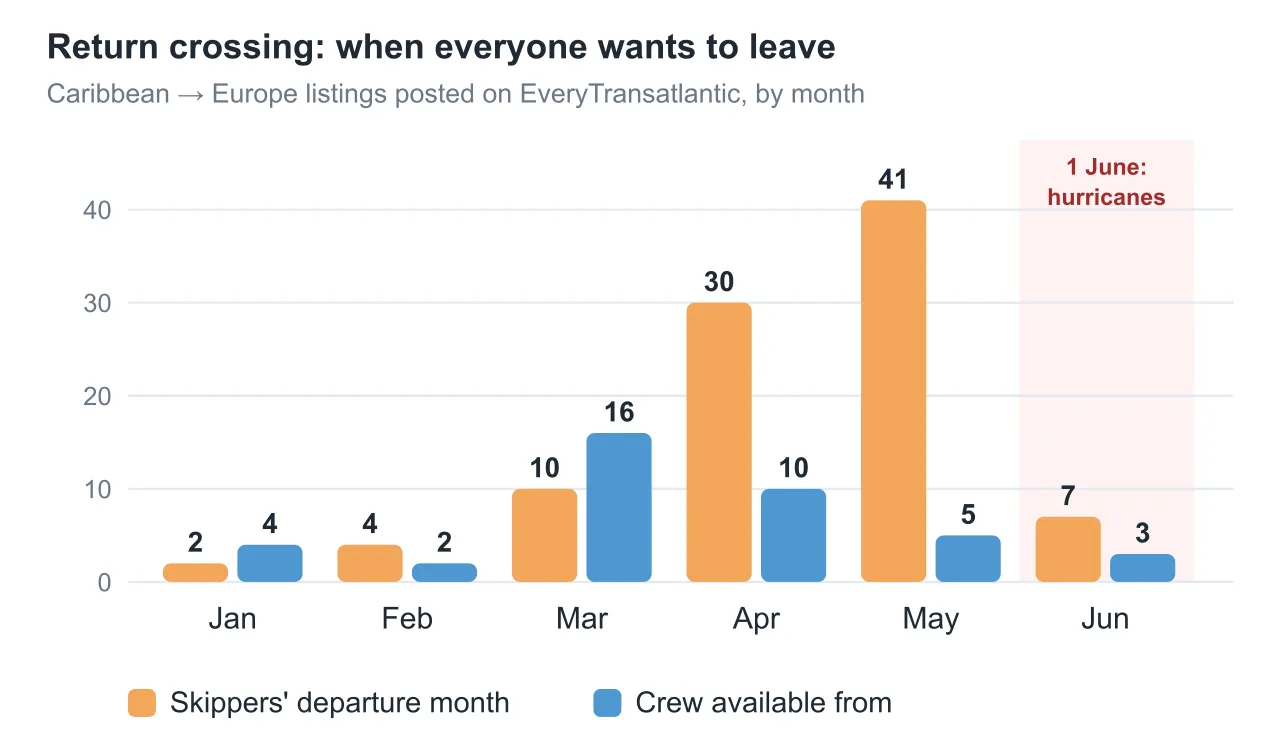
Two mismatches stand out:
- Crew are ready before skippers. Crew availability peaks in March; departures peak in May. A crew member available in March who finds nothing joins another boat, or flies home.
- Skippers post late. 42% of return listings are posted in March or April, often a few weeks before departure. Everyone is searching at the same time.
The classic window to leave the Caribbean is mid-May: the trade winds are well established, and you leave the area before 1 June, the official start of the hurricane season. For reference, ARC Europe 2026 left Sint Maarten on 9 May, left Bermuda on 21 May and finished in Lagos on 21 June.
A timeline that works:
| When | What |
|---|---|
| January | Listing posted: route, legs, dates within 2 weeks |
| February | Messages and calls with candidates |
| March | Crew confirmed. Option to take a crew member on board for a few weeks in the Caribbean |
| April | Boat preparation, provisioning, paperwork |
| Mid-May | Departure, weather permitting |
The trick: offer crew who are available in March the chance to join earlier and sail between the islands before the big departure. They don't slip away, and you test how you get on together before 3,000 miles at sea.
Post my return crossing listing
The route: explain it, and split it up
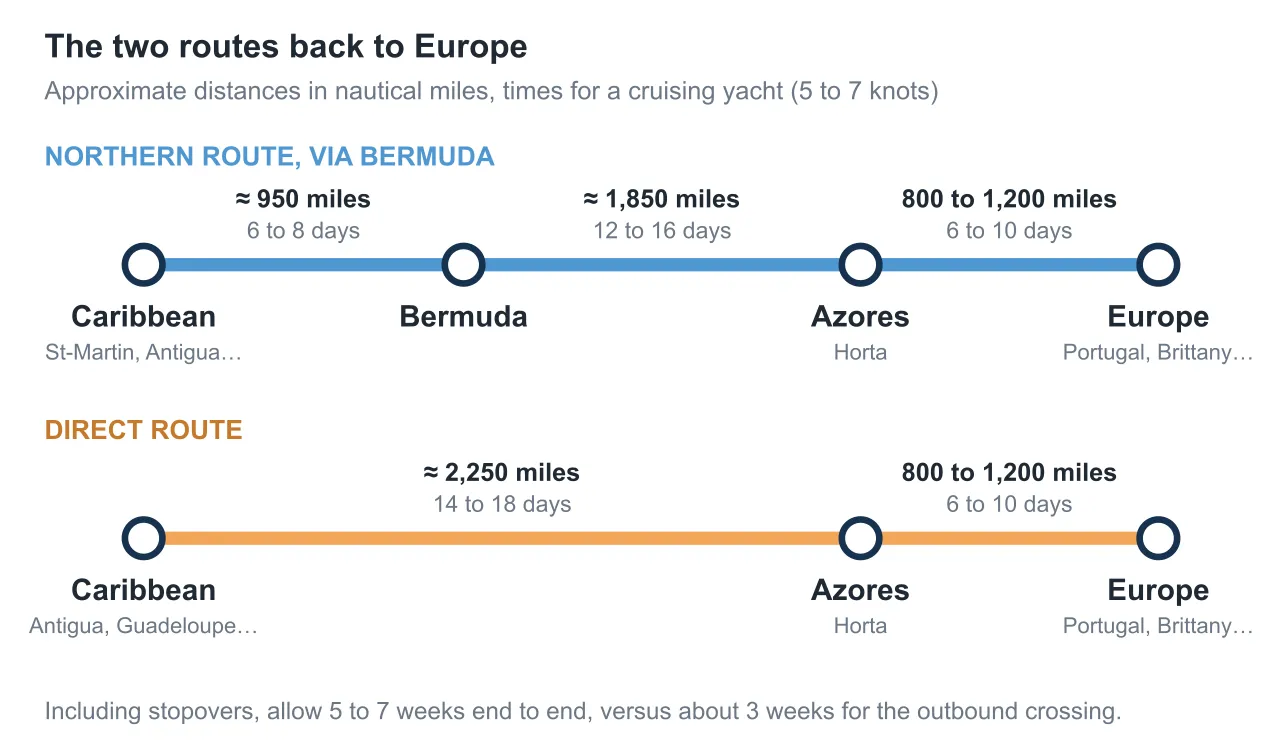
There are two possible routes:
- Via Bermuda: you head north while staying in the trade winds, with a stopover to refuel and, if needed, change crew.
- Direct to the Azores: a single long leg, often with more motoring in the windless areas of the central Atlantic. Carry extra fuel cans.
Either way, landfall is usually at Horta (Faial), before continuing to Portugal, Spain, Brittany or England. Don't linger too long: between the Azores and Brittany, the risk of bad weather rises sharply from August.
Offer legs. This is the most effective lever. Two thirds of skipper listings (67%) mention the Azores, against only 14% of crew listings: crew don't think in legs. Spell it out: "you can join for Caribbean to Azores (3 weeks) or Azores to Europe (10 days)". Someone who can't leave for 6 weeks can often take 3.
How many crew, and who
The return is rarely sailed two-handed. Insurers often require at least three experienced crew for this passage. Check what your policy says before posting.
The conditions explain why. Several crews arriving in the Azores in May reported 40 knots of wind or more between Bermuda and Horta. Reefing and sail changes are more frequent than in the trade winds, and the autopilot has to hold up. Two-handed, fatigue builds up fast.
A good balance for a crew of four:
- one experienced person per watch (at least one who has crossed before);
- one or two motivated people, even with little experience, who can be coached. More on this in our article on organising watches.
The ideal crew is already there. People who have just done the outbound crossing have their sea legs, know life on board and are in the Caribbean. If they haven't booked their flight home yet, they are the first people to contact.
The listing that convinces: a checklist
On the return, your listing competes with twice as many skipper listings as there are crew listings. What makes the difference:
- The route and the legs, with the option to join for part of it only.
- Realistic dates, with a weather margin ("leaving between 5 and 20 May").
- The total duration in weeks, honestly. A surprise about the duration means a crew member leaving in the Azores.
- The cost contribution: the amount per day and what it covers. The median among skippers on EveryTransatlantic is €20 a day (see the study).
- The boat: photos, length, cabins, autopilot, watermaker, communications. A boat page reassures more than a long text.
- You: your experience, your past crossings, the atmosphere you want on board.
- The often forgotten selling point: the trip home. On arrival, your crew are in Europe, a short and cheap flight from home. On the outbound crossing, they have to pay for a transatlantic ticket.
Paperwork to sort out before leaving
- Crew list. Every crew member joining or leaving has to be declared to the authorities. In Antigua, for example, crew stay on board until the captain has completed clearance.
- Entering the Schengen area. The Azores are part of Portugal: they are your entry point into the Schengen area. Non-European crew are subject to the 90 days in any 180 rule; check passports and visas before leaving the Caribbean.
- Insurance. Check that your policy covers crew on board, and the minimum number of crew required.
- A simple written agreement: legs, dates, cost contribution and what it covers, what happens if someone leaves along the way. One page is enough, and it prevents most misunderstandings.
Rules vary between islands and nationalities: check with the authorities at your departure port and with your insurer.
Where to find your crew
- On EveryTransatlantic: 96% of registered members are crew. Post your listing, it's free, then browse crew listings departing from the Caribbean and message them directly.
- On the spot: the harbours where crews change over, such as Falmouth Harbour and English Harbour in Antigua, and marina notice boards.
- Rallies such as ARC Europe, which bring dozens of boats together for the same start.
For more general methods, see also how to find crew for an Atlantic crossing.
Sailing back from the Caribbean this spring?
Post your listing now, before the March peak. It's free and takes 5 minutes.
Frequently asked questions
When should I post my listing for a return crossing in May?
From January, three to four months before departure. Crew are mostly available from March and commit quickly. In March and April, you'll be competing with most other skippers.
Can I leave the Caribbean in June?
It's possible but not recommended: the hurricane season officially starts on 1 June. The vast majority of skippers leave between late April and late May.
Via Bermuda or direct to the Azores?
Via Bermuda, the route is slightly longer but broken up by a stopover, useful to rest, repair or change crew. Direct, it's a single leg of 2 to 3 weeks, often with more motoring. The choice depends mainly on your boat and that year's weather.
Should I ask crew for a cost contribution?
It's common practice: most skippers ask for a contribution to the boat kitty (food, fuel, marinas), around €20 a day on median. On the return, a moderate contribution, or a free leg for an experienced crew member, can make the difference.
Method: 3,144 listings posted on EveryTransatlantic between June 2025 and November 2026, including listings taken from other websites. Outbound: departing Europe, arriving in the Caribbean. Return: departing the Caribbean, arriving in Europe, the Mediterranean or the North Atlantic. Departure month: start date given in the listing. Mentions (Azores, costs…) identified by keywords in French and English: these are orders of magnitude. Distances and durations are approximate; sea conditions: Yachting World; ARC Europe dates: World Cruising Club.