
Return Transatlantic from the Caribbean to Europe: The Best Way to Join a Boat as Crew
On the return leg from the Caribbean to Europe, there are 5 times fewer crew per skipper than on the outbound crossing. Timing, routes, distances and tips to land your berth.
L'équipe EveryTransatlantic4 min read
Contents
Everyone dreams of the outbound crossing: the trade winds, the wind at your back, landfall in the Caribbean before Christmas. As a result, crew are falling over each other for it. The return to Europe, on the other hand, gets the cold shoulder. That is exactly why it deserves your attention.
In short
- On the return leg, there are 1.3 crew for every skipper looking, versus 6.7 on the outbound crossing.
- Departures run from March to June, before hurricane season (June 1).
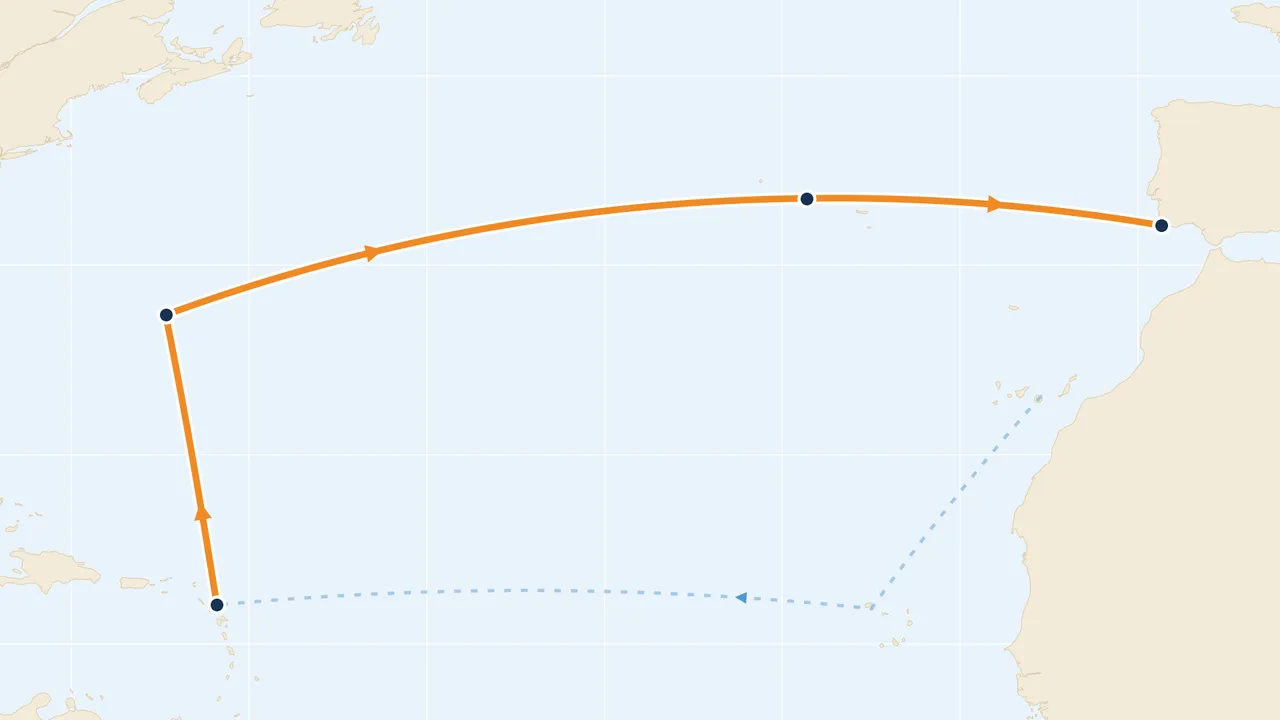
- Classic route: Caribbean, Bermuda, Azores, then Portugal or Brittany. Roughly 3,000 to 3,600 miles, 3 to 5 weeks at sea.
- More demanding than the outbound crossing: cooler, less steady wind, possible gales. A real school of seamanship.
The return: 5 times less competition
We analyzed the 782 listings posted on EveryTransatlantic for a crossing between Europe and the Caribbean, in either direction.
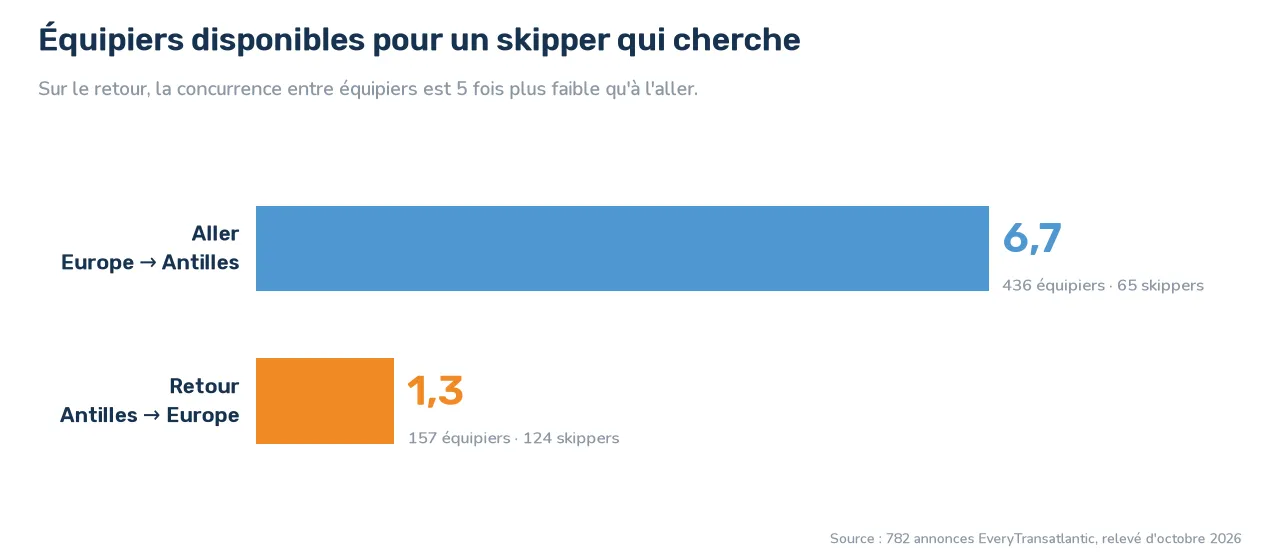
On the outbound crossing, 436 crew compete for 65 skippers. On the return, it's 157 crew for 124 skippers. Many boats that sailed down to the Caribbean in November have to head back north in spring, and some of the outbound crew have already flown home. So skippers are looking for people: on the return, you're the one choosing your boat.
When to go: March to June
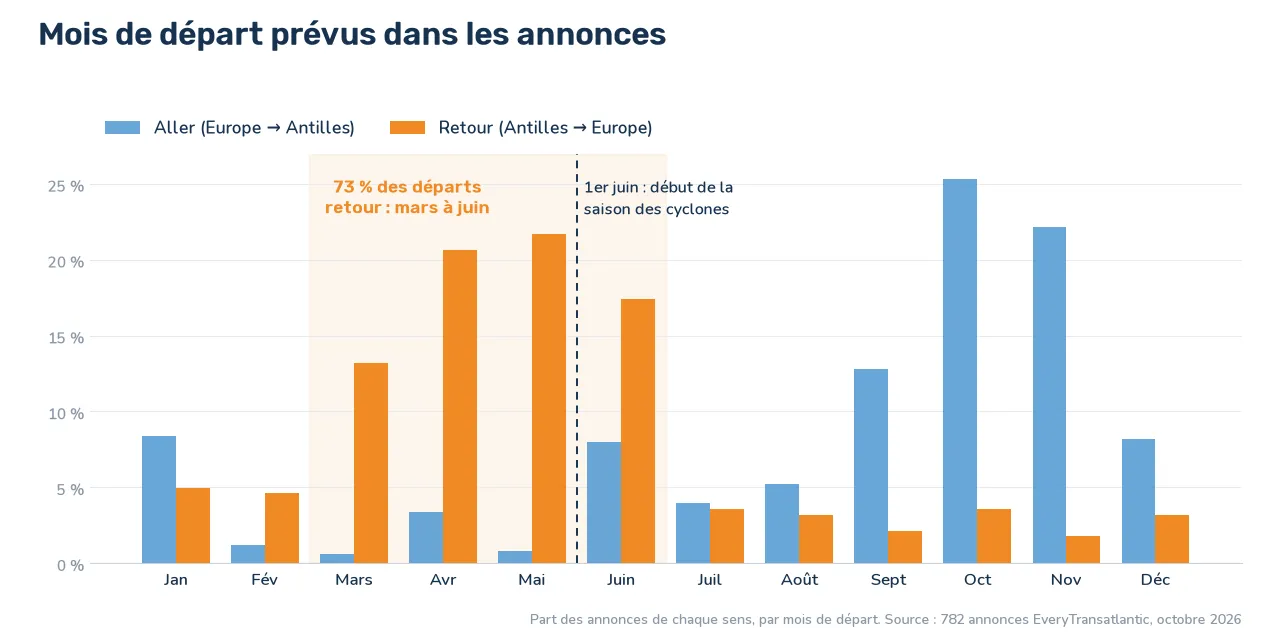
- The North Atlantic hurricane season officially starts on June 1 (NOAA (opens in a new tab)). Boats leave the Caribbean before then, mostly in April and May.
- For example, the 2026 ARC Europe rally left Bermuda on May 21 and reached the Azores in early June (Cruising World (opens in a new tab)).
- Start looking 2 to 3 months before departure, so as early as January or February.
Routes and distances
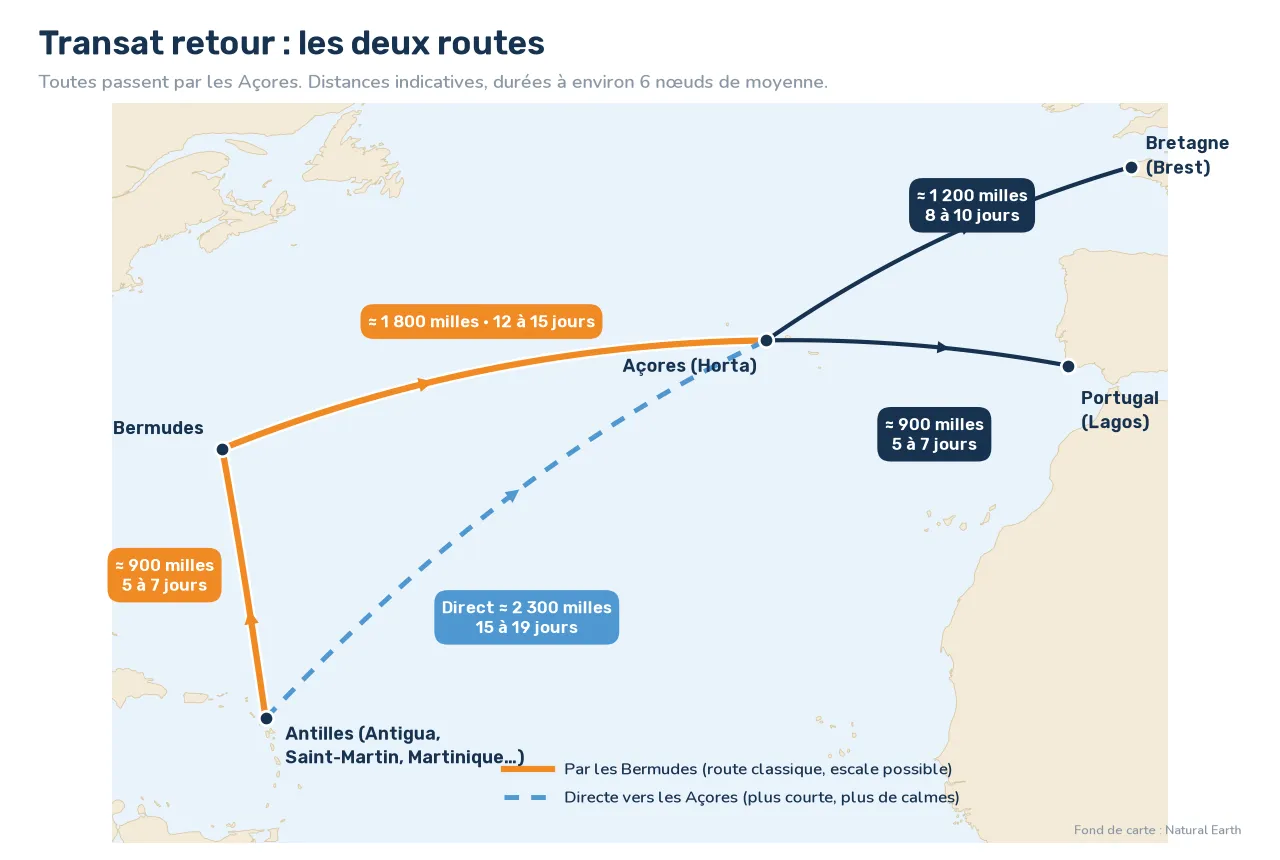
You don't sail back in a straight line: in the middle of the Atlantic, the Azores High creates a vast windless zone. Boats skirt around it to the west and north to pick up the westerlies, hence the stop in Bermuda.
| Leg | Distance | Duration (≈ 6 knots) |
|---|---|---|
| Caribbean → Bermuda | ≈ 850 to 950 miles | 5 to 7 days |
| Bermuda → Azores | ≈ 1,800 miles | 12 to 15 days |
| Caribbean → Azores direct | ≈ 2,200 to 2,450 miles | 15 to 19 days |
| Azores → Portugal (Lagos) | ≈ 800 to 950 miles | 5 to 7 days |
| Azores → Brittany | ≈ 1,200 miles | 8 to 10 days |
The direct distances are based on port coordinates; published logbooks show that boats actually sail 5 to 10% more.
Good to know: the stops in Bermuda and the Azores are also crew change points. You can offer to do a single leg, for example Bermuda → Azores or Azores → Europe.
What's different from the outbound crossing
| Outbound | Return | |
|---|---|---|
| Wind | Steady trade winds, downwind | Variable: on the beam, on the nose, calms |
| Temperature | Warm all the way | Turns noticeably cooler after Bermuda |
| Weather | Stable | Lows to the north: possible gales |
| Engine | Rarely | Often in the high: carry plenty of diesel |
| Duration | 2 to 3 weeks | 3 to 5 weeks, including stopovers |
In 2026, the ARC Europe fleet weathered three gales between Bermuda and the Azores, and one boat that ran out of diesel was refueled at sea by another. Nothing out of the ordinary on this route: that's why a motivated crew is worth its weight in gold here.
Landing your berth: 5 tips
- Target skippers who are looking. See skipper listings from the Caribbean to Europe.
- Be there in March or April: Antigua, St. Martin and Martinique are the main departure ports. Berths are also found on the docks (our guide to boat hitchhiking).
- Offer to do one leg if you don't have 5 weeks: it's often easier for a skipper to fit in.
- Show you're ready for cold weather: foul-weather gear, boots, fleece, headlamp (the complete gear list).
- Talk money from your very first message: contribution to the boat kitty, return flight from the Azores if you get off along the way (the real cost of an Atlantic crossing).
Frequently asked questions
Do you need experience to do the return crossing?
It's preferable, because conditions are more varied than on the outbound crossing. But many skippers will take on a motivated, fit beginner, especially for a single leg. See how much experience you need for an Atlantic crossing.
Can you do just part of the trip?
Yes. Bermuda and the Azores have airports with flights to Europe and North America. Mention it in your very first message.
How much time should you set aside?
For the full trip, allow 4 to 6 weeks including stopovers. For a single leg, 1 to 3 weeks depending on the section.
The return crossing doesn't have the reputation of the outbound one, but it's often where the best sailors are made. And on this route, the odds are on your side.