
How Much Experience Do You Need for an Atlantic Crossing? Everything to Know Before You Cast Off
How much experience do you need for an Atlantic crossing? Discover the key skills, training and advice for crossing the Atlantic safely.
Thomas5 min readUpdated on
Contents
Key takeaways
- Crossing the Atlantic Ocean under sail is a demanding human, technical and logistical adventure.
- Experience level rests on three pillars: technical skills, theoretical knowledge and practical sea time.
- To get started offshore, join a professional skipper or take supervised courses.
- Essential skills: boat preparation, navigation, weather, life aboard, communications and safety.
- Key qualifications: offshore licence, Short Range Certificate (SRC) radio operator's licence and offshore sailing courses.
- Practical experience (coastal sailing, deliveries, boat hitchhiking) is the best school.
Understanding what experience level means for an Atlantic crossing
A mix of technical, theoretical and practical skills Talking about the "experience level for an Atlantic crossing" means, above all, understanding that it rests on three pillars:
- Technical skills: handling manoeuvres on every point of sail, holding a course, helming by day and by night, changing sails, standing watches, and much more.
- Theoretical knowledge: marine meteorology, celestial or electronic navigation, safety rules, onboard mechanics, using nautical charts, etc.
- Practical sea time: nautical miles logged, outings in rough weather, living together aboard, resilience in the face of the unexpected.
You can't improvise an Atlantic crossing. Self-sufficiency is gained at sea and alongside experienced sailors. According to Rubicon3 (opens in a new tab), a sailor's independence is an essential skill – not only for correcting a course but also for dealing with unforeseen weather and technical problems.
Likewise, the Vogweek (opens in a new tab) blog stresses the importance of ongoing offshore training, both theoretical and practical, to ensure safety and adaptability on long passages such as an Atlantic crossing.
Can you cross the Atlantic with no prior experience?
Technically, yes, but not without major precautions. Joining a sailboat run by a professional skipper is one option. It lets you discover offshore sailing without taking on immediate responsibility, while learning on the job. Find out how to use a dedicated crew exchange to cross the Atlantic by sailboat even without experience.
Another possible path: start with supervised courses, then build experience gradually by sailing over varied distances and in varied conditions.
Essential offshore sailing skills for an Atlantic crossing
Boat and safety preparation
- Plan provisioning for several weeks: food, water, gas, fuel.
- Carry a suitable medical kit and know how to use it.
- Have the onboard systems serviced or service them yourself: engine, electrics, rigging, autopilot.
- Know how to manage power generation (solar panels, hydrogenerator, generator, etc.).
Navigation and charts
- Know how to read paper and electronic nautical charts.
- Accurately estimate your position if the instruments fail.
- Plan routes carefully, calculate currents and tides.
- Be able to helm for long periods and in different conditions.
Weather and routing
- Read and interpret weather forecasts (GRIB files, isobaric charts).
- Adapt the route to the conditions of the day or the week.
- Basic knowledge of tropical meteorology (Intertropical Convergence Zone, trade winds, squalls).
Organising life aboard
- Set up a watch system (day/night crew rotation).
- Maintain discipline in daily life aboard.
- Manage tensions and any interpersonal conflicts.
- Communications and safety
- Master the use of a VHF radio and a satellite phone.
- Hold the SRC (Short Range Certificate).
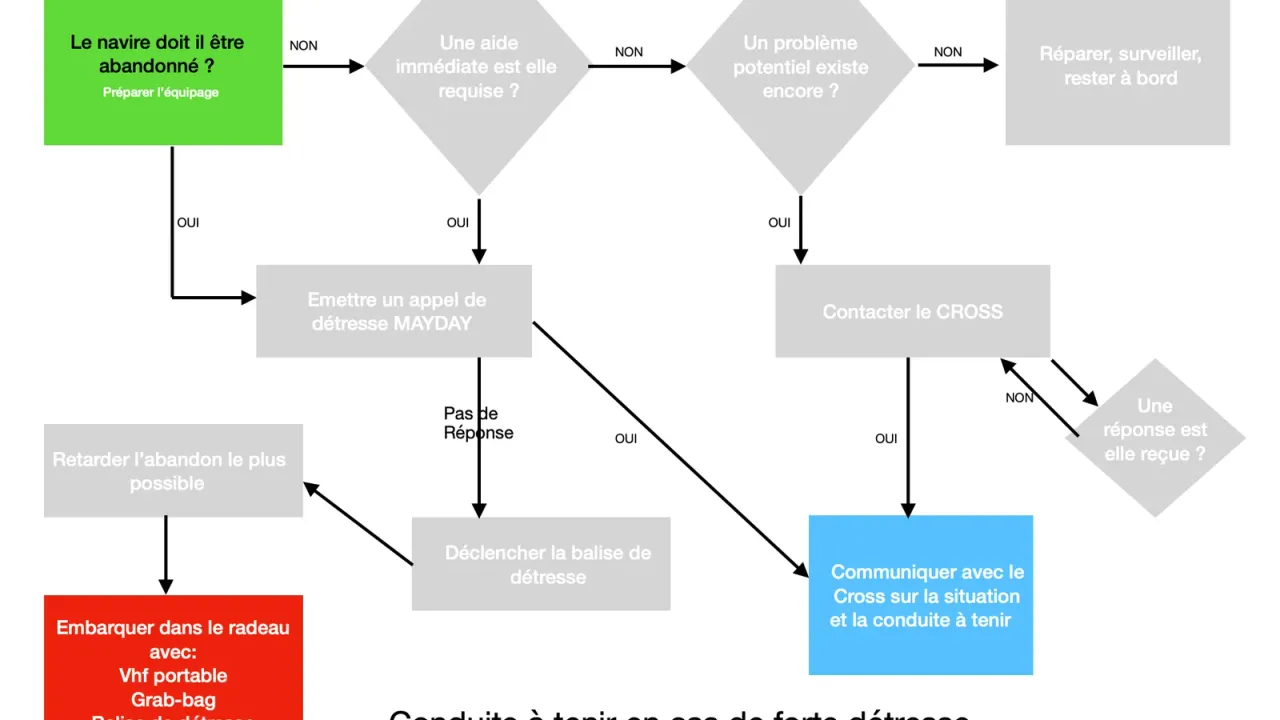
- Practise making a distress call and activating an emergency beacon.
None of these skills are optional. An Atlantic crossing is not ordinary sailing: in the event of a breakdown, you may be isolated for several days. Not knowing how to repair an autopilot or gather weather data can put the crew in real danger.
Train seriously with an offshore sailing course
To reach a good level of experience, several foundational qualifications are available, whether you're a beginner or an experienced sailor:
Offshore licence
- Essential training for sailing with no limit on distance from shore.
- Covers the rules of navigation, chartwork, tidal calculations and safety.
- Requires a prior coastal licence.
SRC (Short Range Certificate)
- Mandatory for operating VHF equipment with DSC (Digital Selective Calling).
- Teaches you how to transmit a distress, medical or safety call.
- A short course, but vital for communication aboard.
Practical offshore courses
- Supervised by professional instructors.
- Immersion aboard for several days or weeks.
- Simulate ocean sailing conditions and help you build reflexes and self-sufficiency.
By combining these courses, you progress quickly and in the right direction. Theory feeds practice, and vice versa. Offshore sailing can't be improvised; it is built methodically.
➡️ Sources: offshore licence and SRC (opens in a new tab), Vogweek blog (opens in a new tab), preparing for the offshore licence (opens in a new tab).
Learning offshore sailing through experience
Use coastal sailing to prepare
- Sailing regularly in coastal or semi-offshore waters is an excellent starting point.
- Racing in regattas multiplies technical situations and demands constant vigilance.
- Sailing at night and in all weathers prepares you for the real conditions of an Atlantic crossing.
Sign up for deliveries or long passages
Joining a crew for a delivery is an effective way to learn: the environment is real, but the setting is supervised. You learn to manage watches and long manoeuvres; see the transatlantic crew exchange.
For a budget-friendly alternative, check out the guide to transatlantic boat hitchhiking.
Learn to reflect on your sailing
Keep a logbook, debrief passages with your crewmates, ask questions, question your choices. This work of reflecting on experience is a major key to progress.
Experience, the only truly reliable school
Despite all the training, some things can only be learned at sea. Salt water, fatigue, mechanical surprises, bad weather: these are the realities that forge true sailors. Resilience, adaptability and the right reflexes can only be developed by sailing, again and again.
Conclusion: Are you ready for an Atlantic crossing?
As you'll have gathered, the experience level for an Atlantic crossing is a precise combination of know-how, attitude and sea time. It's not about collecting certificates, but about making sure you can cross the ocean with self-sufficiency, competence and composure.
So, what sailing level do you need for an Atlantic crossing? It should allow you to:
- Prepare your boat and sail without depending on others.
- Read a chart and anticipate the weather.
- Manage watches, morale and energy aboard.
- Act effectively in an emergency.
This dream isn't reserved for an elite. It's open to anyone who is motivated and curious, ready to learn, to sail, and to grow at sea step by step.
- ➡️ Take a supervised course
- ➡️ Join a coastal delivery
- ➡️ Follow a theory course
- ➡️ Sail with an experienced skipper
Every mile sailed brings you closer to your own Atlantic crossing. The horizon is waiting. It's up to you to start preparing now.