
Watches and Fatigue on an Atlantic Crossing: Staying Sharp at Sea
Sleep debt, night watches, 17 hours awake = 0.05% BAC: how to organise your watch system to stay sharp during an Atlantic crossing.
duthom.936 min read
Contents
Three weeks at sea, watches around the clock, sleep sliced into chunks of three or four hours: on an Atlantic crossing, it is neither the swell nor the wind that wears the crew down the most, it is fatigue. It creeps in silently, and you feel it far less than it affects you. To explore the subject, we drew on the work of Galvanic Works (opens in a new tab), a team of sailors and researchers who set out to measure what we cannot feel.
Why fatigue is the real danger of a crossing
On board, nobody ever gets a full night's sleep. The watch rhythm breaks rest into pieces, and every night leaves a little sleep owing. Over two or three days, you make up for it. Over three weeks, this sleep debt builds up and ends up weighing on everything: reflexes, judgement, patience.
The most treacherous part is that fatigue gives no warning. There is no clear threshold where you tell yourself "I'm no longer fit for this". Instead there is a small lapse in attention: a ship spotted a little late, a reef put off until later, a sheet badly cleated, a tether clip forgotten on the way to the foredeck. Taken in isolation, nothing serious. But it is often this small lapse that comes before the incident.
What the research says
Piero Zucchelli and Natalie Smith, of Galvanic Works, have published two studies on fatigue in recreational sailing (open-access preprints, still awaiting peer review). They build a mathematical model that estimates, hour by hour, the drop in a crew member's performance based on time awake, time of night, accumulated sleep debt and sea state.
A few key takeaways:
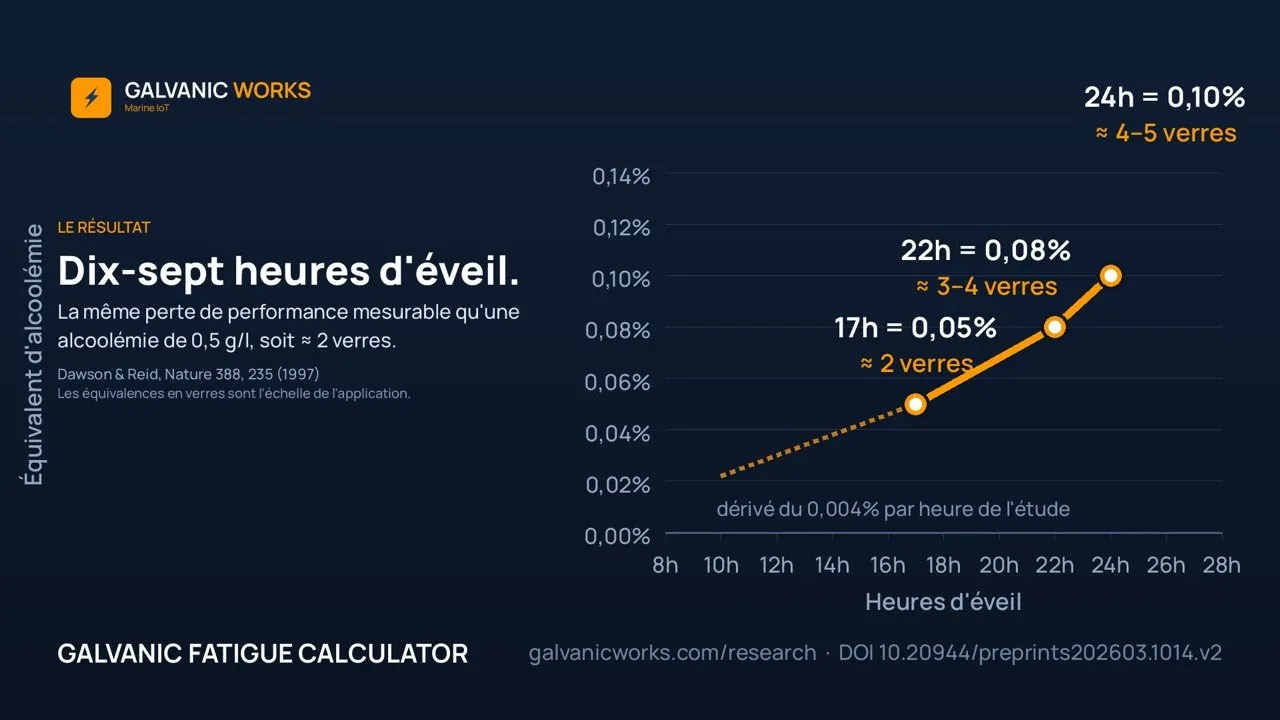
- 17 hours awake is equivalent to a blood alcohol level of 0.5 g/l. After a normal day extended by a first night watch, you are sailing with the same performance as a driver at the legal limit. After 24 hours without sleep, the equivalent rises to around 1 g/l.
- Night amplifies everything. At 3 am, for the same time awake, the impairment is roughly twice as strong as at 3 pm. The low point comes around 2 am: precisely the watch everyone dreads.
- You cannot feel your own fatigue. After the first day, feeling fine becomes a very poor indicator of actual performance. Benchmark studies show that repeated short nights impair abilities as much as a sleepless night, whereas the feeling of sleepiness levels off.
- The sea slows recovery. The time needed to recover goes from about 5 hours in calm seas, with deep sleep, to more than 25 hours in heavy weather, when sleep is broken. A two-hour nap wipes out about a third of "fast" fatigue in calm seas, but barely 7% in a storm.
 The fatigue curve from Galvanic Works' research: after seventeen hours awake, the loss of performance is the same as with a blood alcohol level of 0.5 g/l.
By comparison, the international STCW convention limits professional seafarers to 14 hours of continuous wakefulness. In recreational sailing, there is no such rule: it is up to the crew to organise themselves.
Organising watches on board
There is no perfect system, only trade-offs between sleep duration, the number of people on the helm and the regularity of nights. The most common:
- 3 h / 3 h: short watches, so easier to stay awake through, but sleep periods that are short too, leaving little room for deep sleep.
- 4 h / 4 h: the classic two-watch system. Rest blocks are longer, but the same people risk getting the 2 am watch night after night.
- Staggered watches (Swedish 4/4/5/6/5 system): by alternating watches of different lengths, you get an odd number of watches per day and the slots rotate from one night to the next. Galvanic Works' research shows that this rotation mathematically spreads the night watches fairly between the watches.
- With a crew of three or four, you can keep one person in reserve, shorten night watches or overlap the handovers. Adding a crew member is in fact one of the researchers' most effective recommendations.
Whatever the system, aim for sleep blocks of at least two hours and protect them: no non-essential manoeuvres while the off watch is asleep. For details of the different systems, also read our guide to watches on an Atlantic crossing.
Tips for crew new to night sailing
- Sleep as soon as you're off watch, even if you're not tired. The first few days are a learning curve.
- Get your watch ready before you're woken: warm clothes, red-light head torch, lifejacket and tether ready to put on.
- Take the handover seriously: arrive a few minutes early, get briefed on the course, the sail trim, ships in sight and the expected weather.
- Stay clipped on, lifejacket and tether, from nightfall onwards, even in calm weather.
- Drink, eat, move: a snack and a hot drink help you get through the 2 am low.
- Never hesitate to wake the skipper. A doubt is always better than an incident.
Measuring rather than guessing: the Galvanic approach
It all started with first-hand experience. As Natalie Smith, founder of Galvanic Works, explains:
"The project grew out of our own Atlantic crossings. Offshore, fatigue sets in without warning, and it is often a small lapse in attention that marks the start of a far more serious problem. We wanted to measure what we cannot feel."
From this idea came the Galvanic Fatigue Calculator (opens in a new tab), a free app that applies the studies' model to your own crossing, and works offline. You enter the number of crew, the watch system, the sea state and the length of the crossing, and the app shows, hour by hour, when each crew member reaches their peak fatigue. It is available in French, with no subscription, on the App Store and Google Play. It is a planning tool, not a medical device.
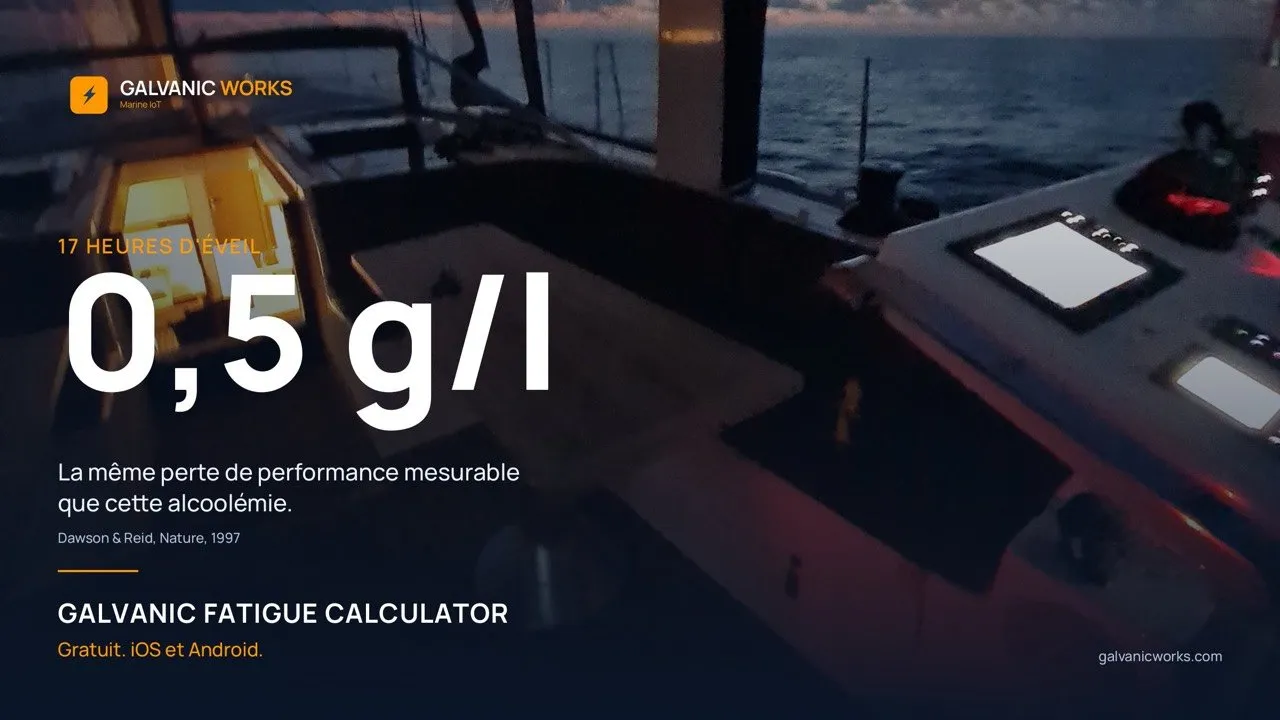 The Galvanic Fatigue Calculator, free on iOS and Android.
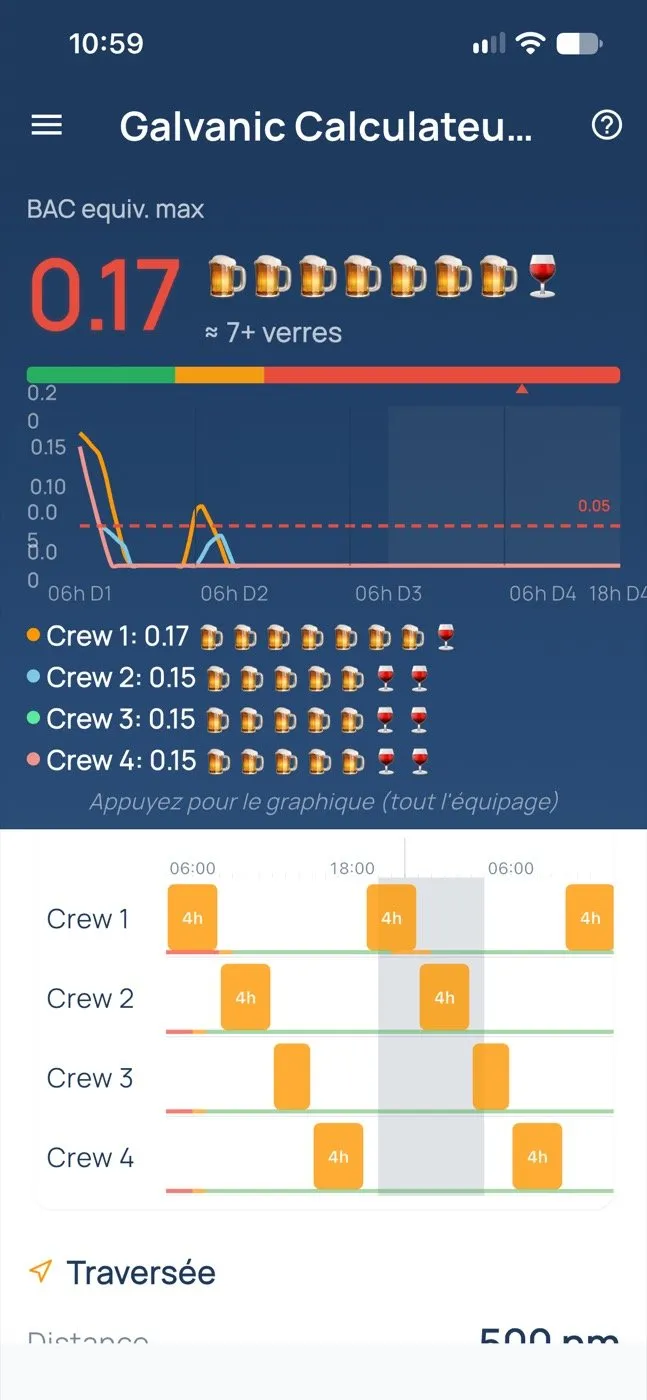 In the calculator: each crew member's fatigue and the watch rotation for a crew of four.
The calculator is part of a wider ecosystem, with Galvanic Sailing, Galvanic Voice, a voice alert system that connects to the boat via NMEA 2000, and Galvanic Pulse, a wristband worn by the crew.
Pre-departure checklist
Rest
- Arrive well rested: no all-nighter of preparation the night before departure.
- Choose your departure time with the day/night rhythm in mind rather than setting off exhausted at the end of the day.
- Provide dark, quiet berths, with lee cloths, earplugs and an eye mask.
- Simulate the first few days with a fatigue calculator to spot the high-risk hours.
Crew organisation
- Choose the watch system and post it at the chart table.
- Check that everyone gets sleep blocks of at least two hours.
- Rotate the night watches so that nobody always gets the 2 am one.
- Set the rules: when to wake the skipper, tethers mandatory at night, handovers on time.
- Factor fatigue into weather routing: a gale also means nights without real sleep.
- Prepare meals that are easy to heat up for the night watches.
Further reading
- Zucchelli P., Smith N., The Science of Fatigue at Sea: A Biomathematical Model for Recreational Sailing (part 1): doi.org/10.20944/preprints202603.1014.v2 (opens in a new tab)
- Zucchelli P., Smith N., Multi-Day Fatigue at Sea: A Two-State Biomathematical Model for Recreational Passage-Making (part 2): doi.org/10.20944/preprints202604.1649.v2 (opens in a new tab)
- The Galvanic Works Research page: galvanicworks.com/fr/research-fr (opens in a new tab)
Preparing a crossing and looking for crew, or a berth on a boat? Browse the listings on EveryTransatlantic.